Polymarket Whale Tracker: Follow the Smart Money in Sports
What the biggest prediction market wallets are doing on tonight's games, and how to read them
GhostLeg, 2026-08-01, 7 min
Numbers in this post were pulled from the live GhostLeg database on Friday, August 1, 2026. Polymarket Whales, GhostLeg's whale tracker, updates continuously, so the wallets and positions you see there today will be newer than the snapshot below.
What is a Polymarket whale tracker?
A Polymarket whale tracker is a tool that follows the largest wallets trading on Polymarket, records every position they take, and grades the results after each market resolves. Because Polymarket runs on a public blockchain, every trade from every wallet is visible on chain. A tracker turns that raw firehose into something useful: which wallets are worth following, what they are backing right now, and whether their track record actually holds up.
GhostLeg runs a live whale tracker focused on sports markets. It discovers high-volume wallets, scores them, builds a graded track record for each one, and rolls their activity into per-game consensus signals you can compare against sportsbook lines. The free tier shows you the board; GhostLeg Pro unlocks the full wallet list and per-wallet dossiers, and you can try it with a free trial.
This post covers how whale tracking works, walks through one real elite wallet from our tracker, and shows how to read whale activity against the books.
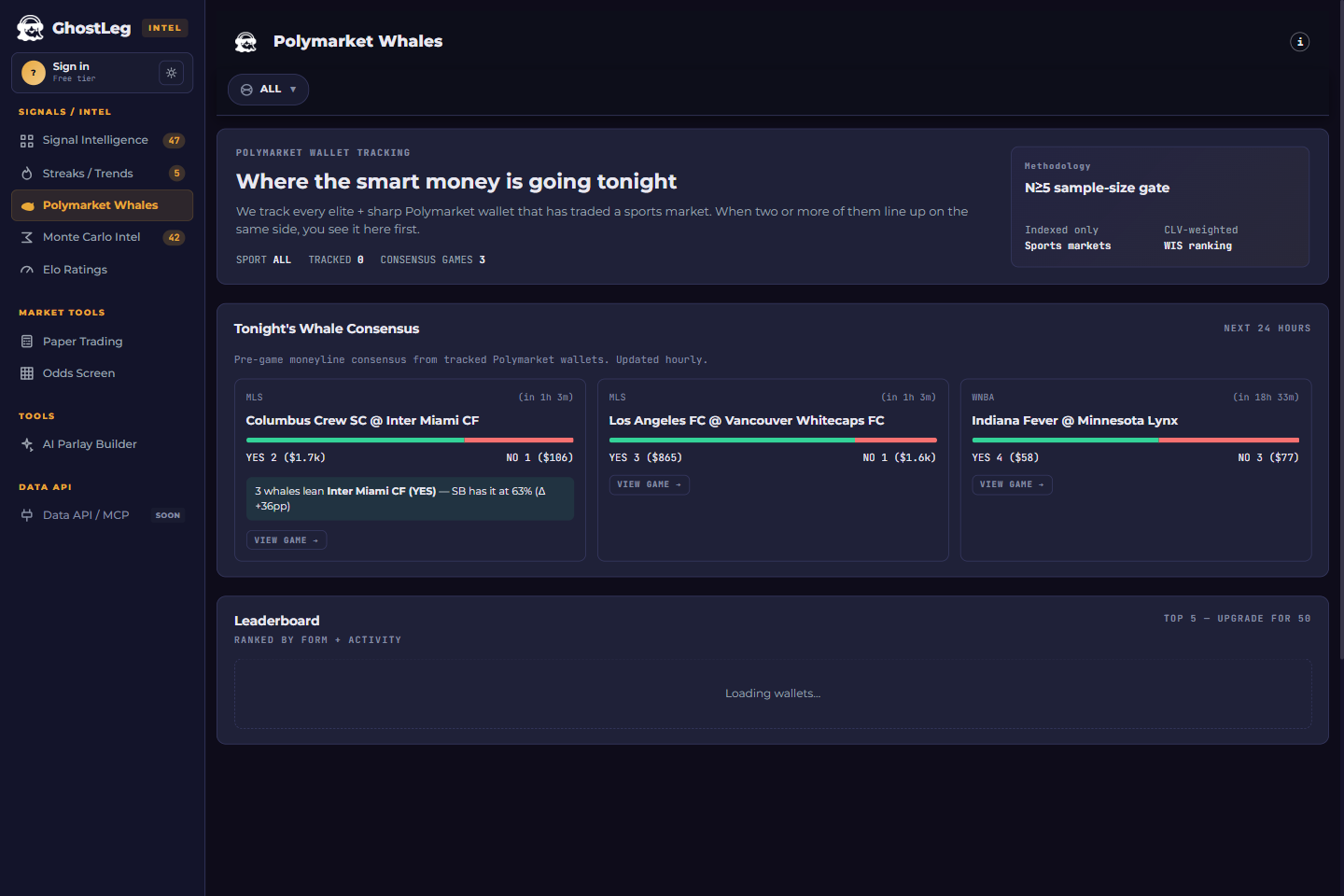
The live whale tracker: tonight's whale consensus per game, with tracked wallet counts, dollar volume on each side, and the gap to the sportsbook line.
Why Polymarket whales are trackable at all
Polymarket settles trades on chain, which means position data is public by design. Anyone can see that a wallet bought a certain number of contracts at a certain price. What nobody can see from the raw chain is whether that wallet is any good.
That is the actual job of a whale tracker. The hard parts are not access, they are curation and grading:
- Discovery. Finding wallets that trade sports markets at meaningful size, out of millions of addresses.
- Grading. Recording the entry price of every position and settling it against the real game result, so a wallet's record is wins and losses at known prices, not vibes.
- Scoring. Compressing that record into a comparable rating. GhostLeg uses a Whale Intelligence Score (WIS) that weighs sample size, returns, and consistency, so a lucky ten-trade heater does not outrank a proven grinder.
- Context. Showing whale positioning next to the sportsbook line for the same game, which is where the interesting disagreements show up.
Sportsbooks publish nothing like this. You cannot see any individual bettor's positions at DraftKings. On Polymarket you can see all of them, and that transparency is what makes prediction markets a uniquely honest place to study how sharp money behaves.
One real whale, tracked and graded
Here is an elite-classified wallet from the live tracker, exactly as our system grades it. The address is truncated the same way the dashboard shows it.
Wallet 0xfe78…0319, snapshot August 1, 2026:
| Metric | Value |
|---|---|
| Classification | Elite (WIS 65) |
| Tracked sports trades | 889 |
| Graded (resolved) trades | 333 |
| Win rate on graded trades | 53.3% |
| Return on investment | +17.4% |
| Average closing line value | +3.9 percentage points |
| Total tracked volume | $1.79M |
| Average trade size | $2,017 |
| Largest single trade | $54,204 |
| Active window | May 3 to August 1, 2026, trading near-daily |
Read that win rate again: 53.3%. Not 70%. This wallet made a +17.4% return while winning barely more than half its trades, because it consistently gets better prices than the market's final word. Its average closing line value is +3.9 percentage points, meaning the market typically moved toward its position after it entered. If you have read our closing line value explainer, this is that lesson in the wild: sharp money is a pricing skill, not a picking skill.
The sport split makes the profile even clearer. This is primarily an MLB wallet: about $1.63M of its volume and 316 of its 333 graded trades are baseball, where it has won 171 times (54.1%) for roughly +$180,000 in graded profit.
A week from its ledger
A few recent settled positions, graded by our pipeline against final scores. Backed team is derived from the graded result, entry price is shown as the implied probability the wallet paid.
| Date | Game | Backed | Entry price | Stake | Result | P&L |
|---|---|---|---|---|---|---|
| Aug 1 | Tigers at Athletics | Tigers | 56% | $32,000 | Won 13-1 | +$25,143 |
| Jul 31 | Phillies at Orioles | Orioles | 52% | $16,000 | Won 6-4 | +$14,769 |
| Jul 31 | White Sox at Rays | White Sox | 44% | $2,369 | Won 6-1 | +$3,015 |
| Jul 31 | Marlins at Mets | Mets | 53% | $19,405 | Lost 5-2 | -$19,405 |
| Aug 1 | Brewers at Angels | Angels | 40% | $16,128 | Lost 6-2 | -$16,128 |
Two things to notice. First, the losses are right there. A real tracker shows a whale's full record; anyone selling you a whale feed with no losses in it is selling you something else. Second, the entry prices cluster in the 40% to 56% band. This wallet is not chasing heavy favorites, it is buying near-coin-flip prices where a few points of edge compound fastest.
Whales versus the sportsbooks
Individual wallets are the micro view. The tracker also aggregates: for each game, how many tracked whales are positioned, at what total volume, and how one-sided they are. That consensus gets computed alongside the sportsbook implied probability for the same game, which is where the tension worth watching lives.
A real example of the data shape: on July 23, Blue Jays against Rays, the tracker logged 13 whale wallets and $26,866 in whale volume forming a strong, high-confidence consensus, while the books had the game priced at essentially a coin flip (49.8% implied). The same per-game whale consensus is available programmatically through the Data API for anyone building on top of it. Whales heavily one-sided on a game the books call even is exactly the kind of disagreement Polymarket Whales surfaces every day, next to the rest of the intel stack: line movement, cross-market divergence, and model probabilities.
We track this cross-venue tension in both directions. Sometimes the whales look prophetic. Sometimes the books were right and the whales donate. The point of grading everything is that you do not have to take anyone's word for which happens more often.
Is there a Kalshi whale tracker?
No, and there cannot be one in the same sense, on any site. Kalshi is a CFTC-regulated exchange with private brokerage-style accounts. There is no public ledger of individual positions, so wallet-level tracking is structurally impossible there.
What is possible on Kalshi is market-level analytics: prices, volume, and how Kalshi's odds diverge from sportsbooks and from Polymarket on the same games. GhostLeg tracks that side-by-side view across both prediction markets and the books, and the whale layer stays a Polymarket-specific superpower, because only Polymarket's on-chain design makes it possible.
How to use the whale tracker
Polymarket Whales, GhostLeg's live whale tracker, is part of the GhostLeg intel dashboard:
- The whale board ranks tracked wallets by WIS with their graded records. Free users see a preview of the board; Pro unlocks the full list.
- Wallet dossiers open a single wallet's full history: sport mix, entry timing, trade ledger, and realized results over time.
- Per-game consensus shows tonight's slate with whale counts, volume, and direction next to the sportsbook line, alongside the rest of the intel dashboard's signals.
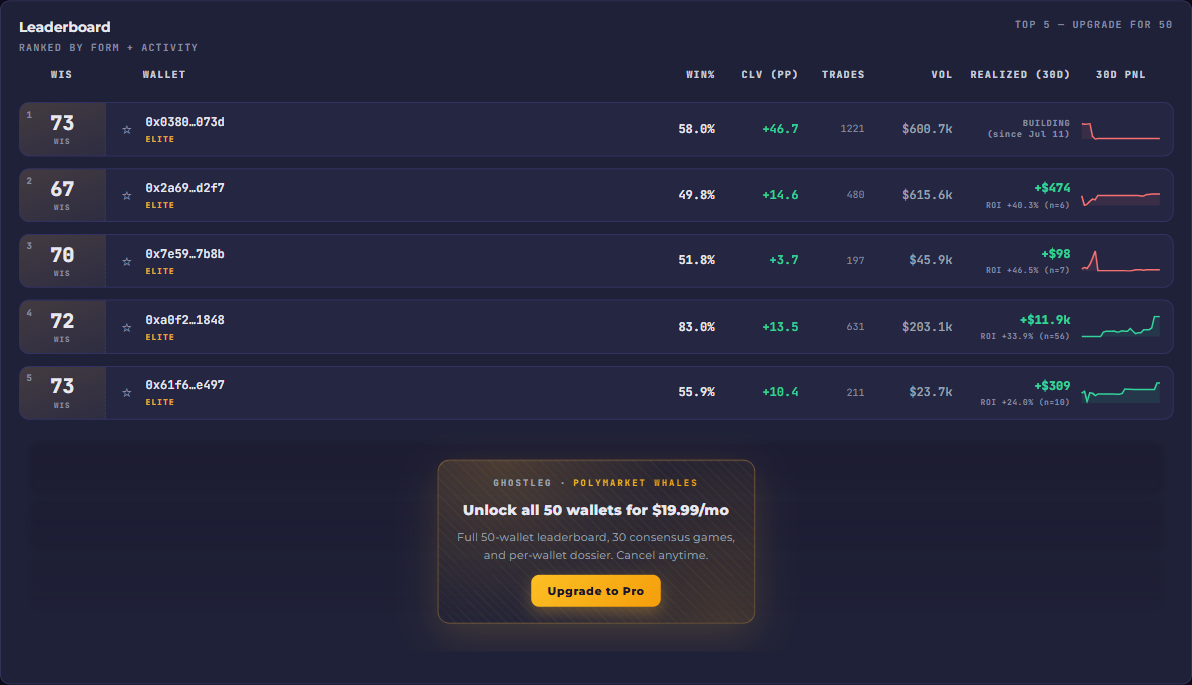
The leaderboard's free preview: five wallets ranked by WIS, each with graded win rate, average CLV, trade count, volume, and a 30-day realized P&L sparkline.
Whale coverage started on moneylines; since September the page also shows whale consensus on spreads and totals, the line the wallets are on, and each wallet's record by market.
If you want this data programmatically instead of on a dashboard, whale consensus is one of the surfaces available through the GhostLeg Data API, alongside odds, line movement, and prediction market history. Sports is where we started; as prediction markets grow into new categories, wallet tracking travels with them.
FAQ
What counts as a whale on Polymarket? There is no official threshold. GhostLeg's tracker qualifies wallets on sustained sports-market volume and position size rather than a single big trade, then keeps them only if they stay active. The wallet profiled above averages about $2,000 per position with peaks past $50,000.
Can you see other people's bets on Polymarket? Yes. Polymarket positions settle on a public blockchain, so every wallet's trades are visible. What a tracker adds is identity persistence, graded results, and scoring, which turn public data into a usable signal.
Does following whales guarantee winning bets? No. Even elite wallets in our tracker lose large positions regularly, including two five-figure losses in the ledger above. The graded record tells you which wallets have been sharp at their entry prices; it cannot tell you the future. Use whale activity as one signal among several, next to line movement and model probabilities.
Why is there no wallet tracking for Kalshi? Kalshi accounts are private, like a brokerage. Only Polymarket's on-chain settlement makes wallet-level tracking possible. For Kalshi, GhostLeg tracks market-level odds and volume instead.
For entertainment purposes only. Past performance does not indicate future results.